Training & Certification
A grounded, relational approach for helping couples find safety and stability after the discovery of betrayal.
Open to clinicians and coaches. Level 1 is also open to clergy.
Developed and led by Dr. Jake Porter, creator of the Couple-Centered Recovery® Model and founder of Daring Ventures in Houston, Texas.

How the training works
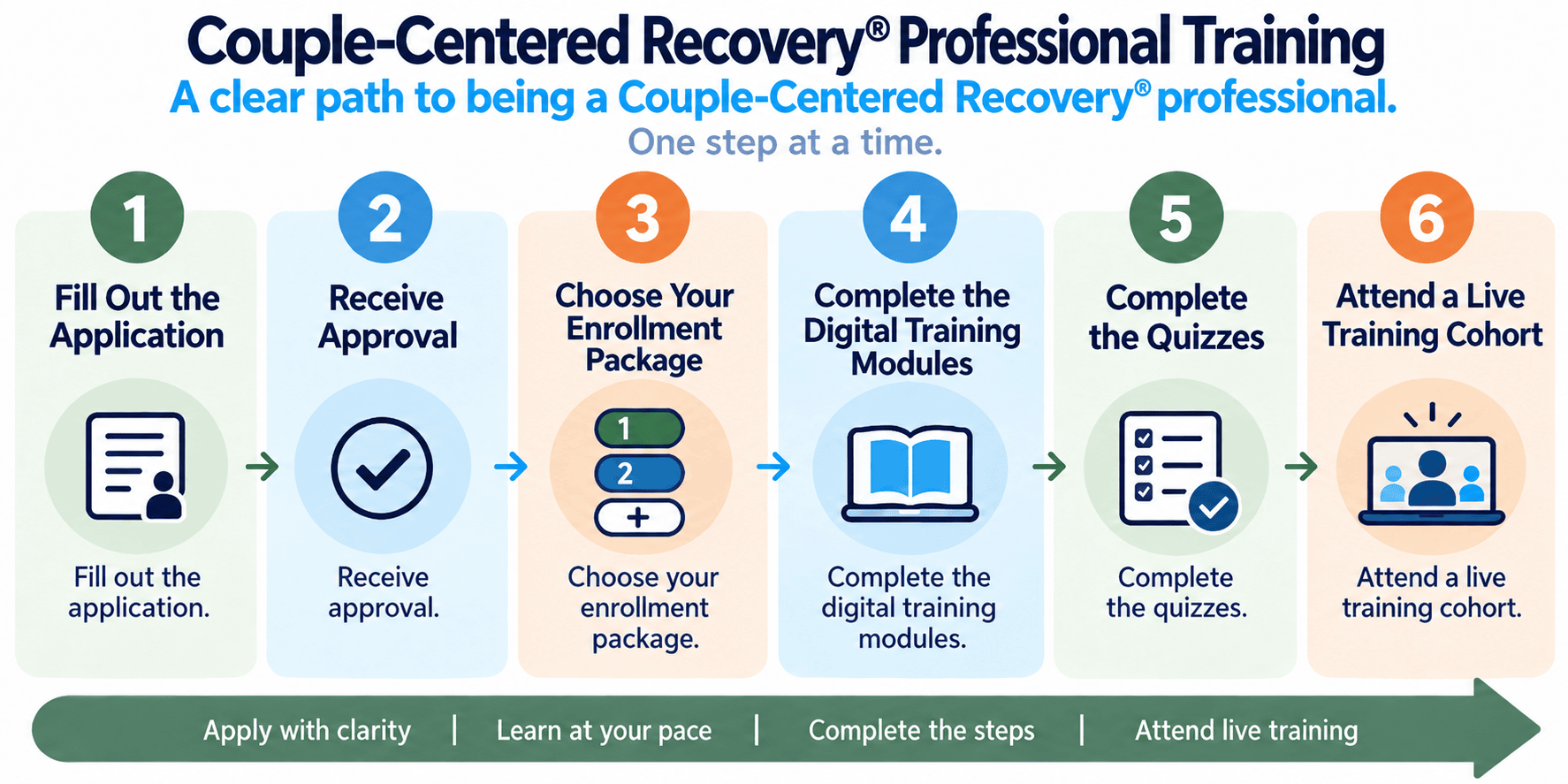
Every level follows the same rhythm. You build your foundation independently, then bring it to life in a live session with other professionals.
Work through the video modules whenever it suits your schedule. After each module, a short quiz lets you check your own understanding before you move on.
Once the digital work is complete, you join us live on Zoom for a session built entirely around putting the model to work. Every live session includes:

The path
Choose the level that fits your training and work today. Each one builds on the last, from foundational skills to full team certification. If you have already completed Level 1, you can begin at Level 2.
The foundational training: the theory the model rests on, the stance you bring to couples, and the core interventions you'll use in the room.
Module 1 · Foundations. Attachment theory, affect regulation theory, developmental neuropsychology, EFT and PACT, revisioning treatment relationally, traditional treatment, the Betrayal Trauma Model, and the Couple-Centered Recovery® Model.
Module 2 · The frame and stance. The roles of coaches and therapists, essential principles, the CCR® stance, the CCR® frame, and the paradigm summary.
Module 3 · Aim and interventions. Tracking and transforming relational dynamics, exposing dysfunctional patterns, and calling clients to values-based self-activation. Basic interventions include cross-tracking, cross-questioning, cross-commenting, Ricochet, Down the Middle, and Normalization. Intermediate interventions include Declarations, Bending Metal, Sculpting, Defense Confrontation, and S.E.T., with clinical demonstrations.
The intermediate training: the full arc of the work, from safety and disclosure through grief and transformation to helping couples re-envision their relationship.
Module 1 · Advanced neurobiology. The embodied mind, affect regulation, self-states, the implicit self, modern attachment theory, mentalization, early relational trauma, dissociation, shame, personality disorders, and betrayal trauma, including its similarities to PTSD and the mechanisms of healing.
Module 2 · Creating safety and stability. Biopsychosocial assessment, the SDI, IPAST, PTSI-R and AAI, co-occurring disorders, contraindications, choosing levels of care, stabilization, emotional regulation skills, normalizing posttraumatic stress, and boundaries.
Module 3 · Disclosures. Preparation of both partners, execution of the process, balancing content with process, outlining the process, and the use of polygraph.
Module 4 · Grieving together. The neurobiology of grief and betrayal, shifting dynamics through shared grief, the impact and restitution letter process, and reconstructing a collaborative narrative through REVAMPS.
Module 5 · Transforming relational dynamics. Posttraumatic stress in the relational system, appealing to secure functioning, exposing regressive cycles, expanding capacity through values, managing thirds, and family-of-origin influence.
Module 6 · Revisioning the relationship. Renewal through posttraumatic growth, reintegrating healthy sexuality, establishing coupleship values, creating new relationship goals, and long-term monitoring of trust.
For teams ready to deliver Couple-Centered Recovery® intensives. Built on Levels 1 and 2, with 35 hours of advanced practicum and consultation.
Advanced practicums (23 hours, online). Conducting successful intensives, safety and stabilization, disclosure, impact and grief processes, relational dynamics, and experiential practicums in trauma, attachment, and personality disorders.
Team consultation (12 hours, online). Completed together as a team, including presentation of recorded work with clients.
Optional shadowing (22 hours, in person in Houston). Observe a Couple-Centered Recovery® Disclosure Intensive with the Daring Ventures team.
Geographic protection. To protect each team's investment, no two teams are placed within a 90-minute drive of each other unless the area's population exceeds 2.5 million. This ratio may change as demand grows.
Certification benefits. A free premium listing on the IACCR Provider Directory, plus priority referrals from Daring Ventures for clients seeking care and for aftercare following intensives.
Live training dates
Complete the online modules at your own pace, then join the live day (or days) below on Zoom. All sessions run 9:00 am–2:00 pm Central. Level 1 is one live day; Level 2 is two consecutive days.

Continuing education. CEUs for this training are sponsored by Kairos University, a regionally accredited institution. Participants are responsible for confirming CEU eligibility with their own licensing or certification boards.
Your trainer
Creator of the Couple-Centered Recovery® Model
Dr. Jake Porter is an internationally known psychotherapist, coach, trainer, and speaker on relational dynamics, trauma, and spirituality. Couples travel from around the world to his Houston clinic, Daring Ventures, for transformative intensive work using his Couple-Centered Recovery® Model.
His methods draw on performance psychology, developmental neuroscience, attachment theory, and spirituality to deepen clients' capacity for connection. He leads several businesses and non-profits, hosts a podcast, works as an executive leadership coach and practice-building consultant, and serves as Professor of Counseling at Kairos University.
He lives in Houston with his wife, Kristen, and their daughters, Magnolia Jane and Lottie Jo.
Begin
Choose the level that fits where you are now and apply below. Once you're approved, we'll email a secure link to complete your enrollment.
Questions about team certification? Contact us via this form